

You rested it, iced it, and stretched it. Weeks later, that elbow, knee, or shoulder still aches every time you play, lift, or run.
PRP therapy for sports injuries sits between conservative care and surgery. It is not a cure-all, and it does not suit every injury. But for the right person with a stubborn tendon or joint problem, it can be worth a serious look.
Knowing how it works, who it tends to help, and what recovery really looks like makes that decision easier.
PRP stands for platelet-rich plasma. It is made from a small sample of your own blood, drawn from your arm much like a routine lab test.
That blood is spun in a centrifuge to concentrate the platelets, which carry growth factors involved in tissue repair. The concentrate is then injected into the injured area, with ultrasound guidance so it lands exactly where it is needed.
The goal is to support healing in slow-healing tissue, especially tendons, rather than simply mask pain. That is a key difference from steroid injections, which often ease pain faster in the first few weeks, while PRP is aimed at longer-term improvement.
PRP for tendonitis and other chronic tendon problems gets the most attention. It is most often considered for:
PRP fits long-running problems, not fresh injuries. A new sprain, a fall, or sudden swelling needs an exam and often imaging first, which is where sports injury treatment and on-site X-ray come in.
PRP research is promising but uneven, and results depend heavily on the condition being treated.
Outcomes also vary from person to person, which is why a proper evaluation matters more than any single study.
PRP may be a good fit if you:
PRP may not be right if you have:
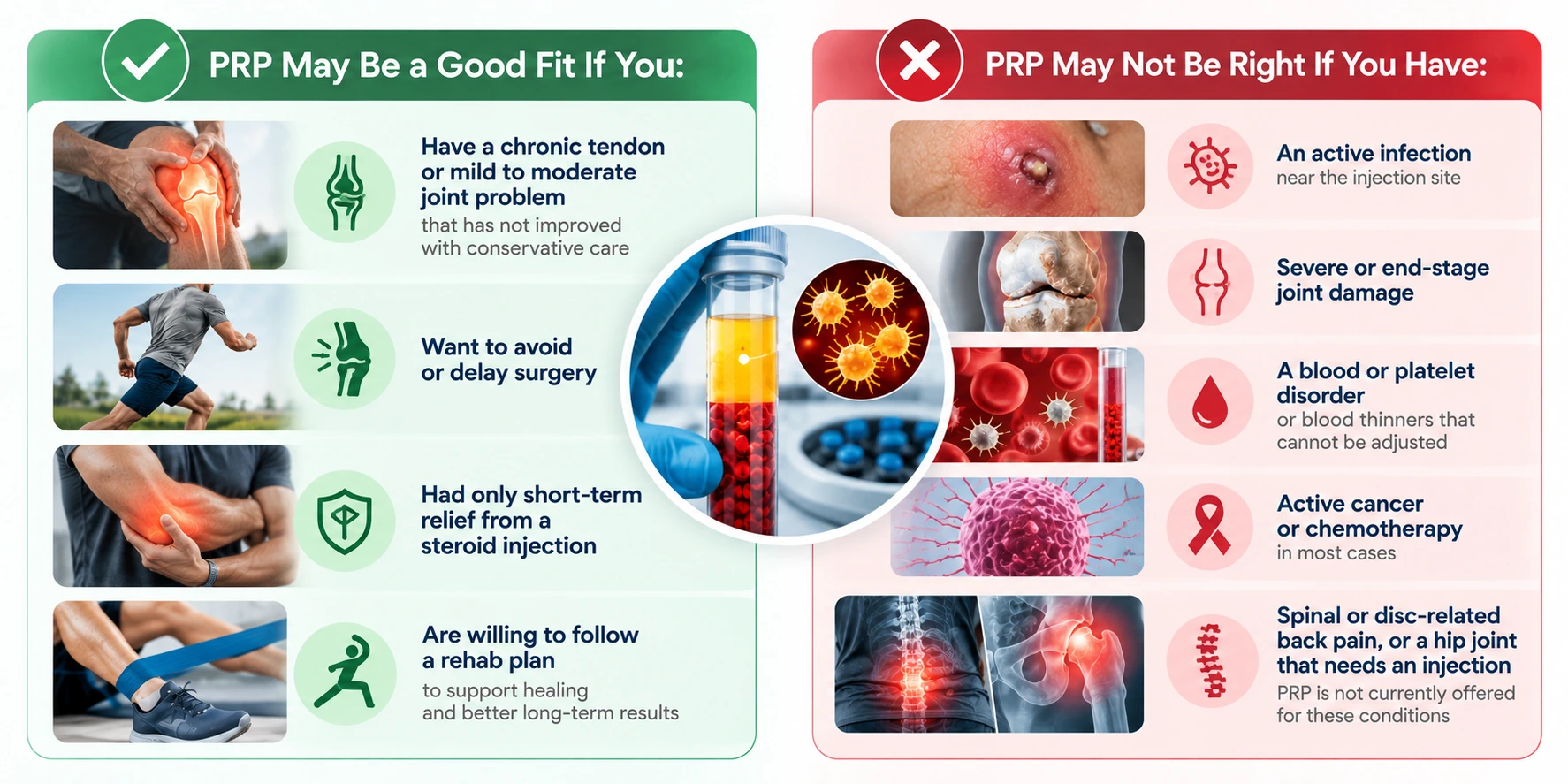
A consultation and medical review decide candidacy, so treat this list as a starting point, not a diagnosis.
It starts with a consultation. Your provider reviews your history, your medications, and any imaging you already have, then decides whether PRP makes sense for your injury.
If it does, the visit is straightforward. Blood is drawn, processed, and injected under ultrasound guidance, all in one in-office appointment.
Is a PRP injection painful? Expect pressure and some discomfort during the injection, followed by soreness that usually settles within about a week. Your provider will explain what to expect for the area being treated.
Some people improve after one injection, while many do a series spaced several weeks apart. PRP is self-pay and not covered by insurance, so it helps to review the current PRP pricing first.
How long does PRP take to work? Gradually. Most people notice improvement over several weeks, not days, and healing continues for up to 12 weeks.
Improvement is gradual, not immediate, and a sore first few days is a normal part of the process.
Because PRP uses your own blood, the chance of an allergic reaction is low. The most common effects are soreness, swelling, and bruising at the injection site, which typically fade within days.
Infection and bleeding are rare, as with any injection. Call your provider if redness, swelling, or pain keeps increasing after the first day or two instead of easing.
Tell your provider about every medication you take, including blood thinners and anti-inflammatories, before treatment. That review is part of why a consultation comes first, and it helps avoid complications or a weaker response to the injection.
PRP may help chronic sports injuries, the research is mixed, and a proper evaluation comes first. If an injury has lingered despite rest and rehab, it is worth asking whether PRP fits.
Request a consultation with MI Express Urgent & Primary Care to find out whether PRP is the right next step for your injury.
Cortisone is a steroid that reduces inflammation and often eases pain quickly. PRP uses platelets from your own blood and aims to support tissue healing over time.
It depends on the injury. Some people improve after one injection, while others do a series of three to five, spaced several weeks apart.
Light activity is usually fine right away, but avoid high-impact exercise for the first week. Full return depends on the injury, and healing continues for up to 12 weeks.
Usually not at first. NSAIDs like ibuprofen and naproxen may interfere with healing, so avoid them unless your provider says otherwise.
No. PRP is self-pay, and insurance is not accepted at this time. Current rates are on the PRP therapy page.