


Shockwave therapy has become a leading non-invasive treatment for chronic pain, tendon injuries, and tissue healing. It uses acoustic waves to stimulate blood flow, promote cellular repair, and accelerate recovery. However, not all shockwave devices perform the same, and technological differences can directly impact treatment effectiveness.
StemWave technology is a next-generation advancement in shockwave therapy that delivers precise, deep, and comfortable treatments.
Understanding how it differs from traditional devices can help patients and providers make informed decisions about non-surgical pain relief.
Shockwave therapy sends high-energy acoustic waves into damaged tissues. These waves jump-start your body’s natural healing response, improving blood flow, reducing inflammation, and promoting tissue repair.
Shockwave therapy is commonly used for:
Chronic joint pain
Tendonitis and ligament injuries
Plantofasciitis
Calcific shoulder tendinopathy
However, the efficacy of the treatment is dictated by how that energy is delivered to the tissue.
[Image comparing radial and focused shockwave therapy wave dispersion patterns]
Radial shockwave devices generate waves that spread outward in a broader pattern, similar to ripples in water. They are often used for superficial conditions like heel spurs or muscle knots.
Limitations:
Limited penetration depth (often only 1–2 cm)
Less precise targeting of deeper tissue
May require higher pressure to achieve therapeutic effect, causing discomfort
Focused devices deliver concentrated waves to specific tissue areas. This type can target deeper structures like ligaments, joints, or thick tendons.
Strengths:
Higher precision and deeper tissue stimulation
Effective for stubborn tendon or joint issues
Challenges:
Some patients find focused waves uncomfortable
Proper technique is essential to avoid inconsistent results
While both radial and focused devices have clinical value, traditional shockwave therapies can have drawbacks:
Limited energy depth or inconsistent wave dispersion
Inaccurate tissue targeting in complex injuries
Discomfort during treatment sessions
Variable outcomes depending on provider experience
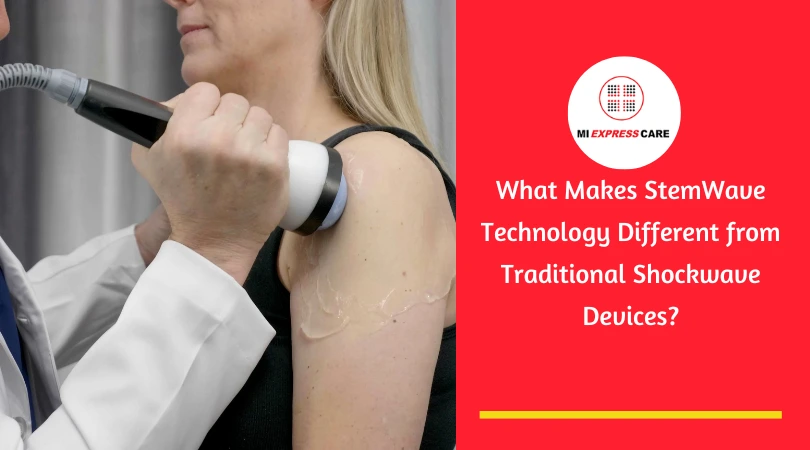
StemWave technology is an advanced form of focused shockwave therapy that combines precision engineering with consistent energy delivery. Its design allows acoustic waves to penetrate deeper tissue layers while maintaining a non-invasive, patient-friendly approach.
Unlike older devices, StemWave integrates advanced wave modulation to optimize energy distribution, reducing discomfort while enhancing tissue stimulation and healing.
StemWave technology was developed to overcome the comfort, consistency, and depth limitations commonly associated with traditional shockwave devices.
Advanced Energy Delivery: StemWave delivers broader yet precise wave coverage without the need for excessive pressure.
Precision Without Excess Pain: Its non-invasive design improves patient comfort. Sessions are more tolerable.
Deeper Tissue Stimulation: StemWave can reach muscles, tendons, ligaments, and joints effectively.
Efficient Treatment Sessions: Sessions are typically shorter than traditional shockwave treatments, with minimal downtime.
| Feature | Radial Shockwave | Focused Shockwave | StemWave Technology |
|---|---|---|---|
| Technology Type | Pressure Wave | Convergent Acoustic | Area Directed Acoustic |
| Treatment Depth | Shallow (3-4cm) | Very Deep (Up to 12cm) | Deep & Broad |
| Comfort Level | Moderate | Can be High Pain | Low to Moderate |
| Session Duration | 15-20 Mins | 15-20 Mins | 10-15 Mins |
| Primary Goal | Superficial/Large Areas | Deep/Specific Points | Deep/Comprehensive Healing |
StemWave therapy is commonly used for musculoskeletal conditions involving chronic pain or soft tissue injury, particularly when deeper tissue stimulation is needed.
Conditions that may benefit from stemwave treatment include:
Chronic joint pain
Tendon injuries
Muscle strains
Plantar fasciitis
Sports-related injuries
A StemWave treatment typically begins with a clinical evaluation to determine the appropriate treatment plan. During the session, patients may experience gentle pulsing or pressure in the targeted area, which is generally well tolerated.
Depending on the condition and individual response, a series of sessions is commonly recommended, often ranging from three to six treatments.
StemWave is a non-surgical, non-invasive treatment. It is FDA-cleared for the treatment of various musculoskeletal conditions and has an excellent safety profile. It is an ideal alternative for those looking to avoid injections or surgery.
The technology is only as good as the clinician operating it. When seeking relief, look for providers who utilize modern StemWave technology and have a deep understanding of bio-mechanics. The right device, paired with a customized treatment plan, is the key to moving from chronic pain back to an active lifestyle.
Shockwave therapy effectiveness is shaped not just by the treatment itself, but by how acoustic energy is delivered to the body. Traditional devices vary in depth, comfort, and precision, which can influence outcomes. By integrating advanced focused acoustic waves with consistent energy control, StemWave technology addresses many of these limitations. Understanding these differences helps patients make informed choices when considering modern, non-invasive pain management options.
Discover how advanced shockwave technology can make a difference in your recovery. At MI Express Urgent & Primary Care, our team guides you through StemWave therapy, showing how it targets pain more precisely and comfortably than traditional methods.
Schedule your consultation today and take the first step toward smarter, non-invasive musculoskeletal care.
StemWave uses high-energy acoustic waves that penetrate deeper tissue, stimulating cellular repair and circulation, unlike ultrasound or laser therapy, which primarily affect surface-level structures.
StemWave can complement physical therapy, rehabilitation exercises, or other conservative treatments, supporting tissue healing and improving mobility while enhancing overall treatment effectiveness.
Treatment plans usually involve three to six sessions, depending on the condition, tissue response, and individual recovery needs for optimal outcomes.
Individuals with active infections, certain blood disorders, or pregnancy may need alternative care and should consult a clinician before starting treatment.
Coverage varies by insurance provider and plan; many patients may pay out-of-pocket or use supplemental benefits for musculoskeletal therapy services.