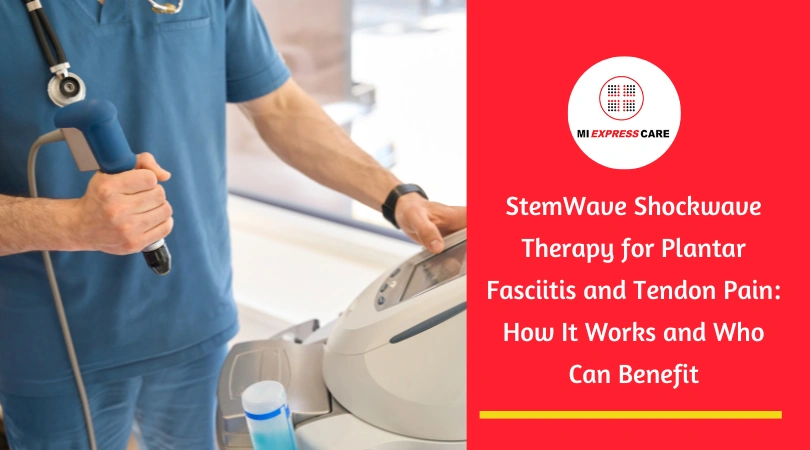



You've rested it. Stretched it. Swapped your shoes, maybe run through a round of physical therapy. And the heel pain or that nagging tendon ache still turns up. Plantar fasciitis and tendon pain have a way of digging in and staying, long after the usual fixes should have worked.
StemWave is a non-invasive acoustic wave treatment that offers for certain chronic soft-tissue conditions. Despite the name, it is not stem-cell therapy and involves no injections. Results vary from person to person, and a clinical evaluation always comes first. Here's how it works and who tends to benefit. You can also see our dedicated shockwave therapy page for details.
StemWave delivers focused acoustic energy, essentially high-energy sound waves, into targeted muscles, tendons, ligaments, and connective tissue. The goal is to stimulate a local healing response, improve circulation, and support the body's own tissue recovery in the treated area.
Unlike medication, steroid injections, or surgery, the treatment uses no needles and no incisions. It's an in-office option for chronic tendon, ligament, and soft-tissue problems. For a closer look at the underlying technology, see our overview of what shockwave therapy is and why it's used for pain relief.
Plantar fasciitis comes from repetitive strain on the plantar fascia, the band of tissue supporting the bottom of the foot. The classic sign is heel pain that's worst with your first steps after rest. Prolonged standing, sudden training changes, added load, and foot mechanics all feed into it.
Tendon pain often builds from repeated overuse or improper loading, degenerative changes within the tendon, and continued activity without enough recovery. It commonly shows up in the Achilles tendon, elbow, knee, and shoulder. In both cases, overload and repetitive stress are usually why the pain lingers rather than fading on its own.
A typical StemWave visit follows a clear sequence:
1. The provider reviews your symptoms, activity level, and medical history.
2. A mapping evaluation pinpoints the painful or injured area.
3. Gel is applied to help deliver the acoustic energy into the tissue.
4. A handheld applicator sends controlled pulses into the targeted area.
5. The intensity is adjusted based on your condition and comfort.
Most sessions take roughly 5 to 10 minutes and generally require no downtime, so most people head back to their day afterward.
StemWave is used primarily for persistent soft-tissue conditions, including:
MI Express Urgent & Primary Care currently offers StemWave for plantar fasciitis, chronic tendinitis, Achilles pain, elbow conditions, shoulder pain, strains, and other soft-tissue injuries. If you're weighing your options, our post on what makes StemWave technology different is a helpful next read.
StemWave may be worth considering for patients who:
It's usually a better fit for a persistent, diagnosed soft-tissue condition than for a brand-new, undiagnosed injury, which is one reason the evaluation matters.
StemWave isn't right for everyone. Treatment needs careful evaluation, and may not be appropriate, for patients with:
Temporary effects can include discomfort, skin redness, swelling, or bruising in the treated area.
During a session, most people feel mild pulsing or pressure and some temporary discomfort. Afterward, expect little to no downtime, though short-term tenderness or soreness is possible. A few things to keep in mind:
No honest provider can promise immediate relief or a guaranteed number of treatments, because the response depends on your diagnosis and how severe the condition is.
No. Shockwave therapy usually works best as one part of a broader care plan, not a substitute for the basics. For lasting results, the following still matter:
Rehabilitation helps address the mechanical factors driving recurring pain, which is why combining shockwave treatment with stretching and appropriate loading tends to make more sense than relying on any single approach.
Some symptoms call for a medical assessment before considering StemWave. Get evaluated first if you have:
These can point to a fracture, tendon tear, nerve problem, or another condition that needs a different treatment approach entirely.
Hearing from someone who has been through the treatment says more than any description can. In the video below, Raffi, an active patient recovering from a torn ACL and menisci, shares his StemWave experience in his own words.
A few sessions in, he noticed a real difference:
“Over time it's been really, really helpful. I play sports on a regular basis, and I'm glad that the pain and the annoyingness that I used to feel is reducing over time, so I feel like it's a very, very effective procedure.”
For Raffi, StemWave became a supplement to his training that helped him keep doing what he loves. As he put it, “those are the combinations that are working.”
Raffi's results reflect his own situation, and every case is different. That's why the first step at MI Express Urgent & Primary Care is a mapping evaluation, so a provider can tell you whether shockwave therapy is a reasonable option for you.
If chronic plantar fasciitis or tendon pain has held out against rest, stretching, and physical therapy, StemWave may be worth a closer look. The first visit is a mapping consultation to determine whether your condition is likely to respond, so you get a straight answer before committing to treatment.
Still dealing with heel or tendon pain despite conservative care? Schedule a StemWave mapping consultation at MI Express Urgent & Primary Care in Canton or Ann Arbor to find out whether shockwave therapy may be appropriate for you.
No. Despite the name, it doesn't use or inject stem cells. It uses focused acoustic waves to prompt your body's own healing response, with no needles and no harvested cells.
Most people feel a pulsing or pressure and some temporary discomfort, and the intensity is adjusted to your comfort. Any soreness afterward is usually short-lived.
It varies. Many patients need a series rather than a single visit, and the number depends on your diagnosis and how the tissue responds. Your provider gives you a realistic estimate after the mapping evaluation.
Usually right away. Sessions generally require no downtime, so most people return to their day afterward, though your provider may suggest some activity adjustments.
These are among the conditions it's most often used for. Whether it's likely to help in your case depends on your specific diagnosis and severity, which the mapping consultation is designed to assess.