


Michigan summers mean lake days, trail hikes, and evenings on the porch. They also mean bugs. Most bites are nothing, just a little redness, some itching, gone in a day or two. But occasionally a bite sticks around, swells up, or starts looking worse than it should. That's when knowing what you're dealing with actually matters.
Sand fly bites, mosquito bites, and spider bites are among the most common concerns for Michigan residents during warmer months. They don't always look the same, they don't always behave the same, and they don't always call for the same response. Here's how to tell them apart, and when to stop treating them at home.
It comes down to geography. Michigan has more than 11,000 inland lakes, thousands of miles of wooded terrain, and summers that are warm and humid, everything biting insects need to thrive. Mosquitoes breed in standing water. Sand flies cluster near shorelines and low-lying areas. Spiders are everywhere tall grass and wood piles are.
Peak season runs from late May through September, with June through August being the worst of it. The more time you spend near water, in wooded areas, or in tall grass during those months, the higher your exposure. It's less a question of if you'll get bitten and more a question of by what.
Sand flies are easy to miss, they're small, quiet, and most active around dusk and dawn. By the time you notice them, the damage is done.
Their bites tend to show up as small red bumps, often in tight clusters because sand flies bite repeatedly in the same area. They favor exposed skin: ankles, lower legs, arms, the back of the neck. The defining feature is the itch, disproportionately intense for how minor the bite looks.
Other symptoms include mild swelling and a burning or stinging sensation at the site. Most people also notice that the itch lingers longer than a typical mosquito bite.
At home, wash the area with soap and water, apply a cold compress, and use an over-the-counter antihistamine or anti-itch cream. The main thing to avoid is scratching. Breaking the skin turns a minor irritation into a potential infection.
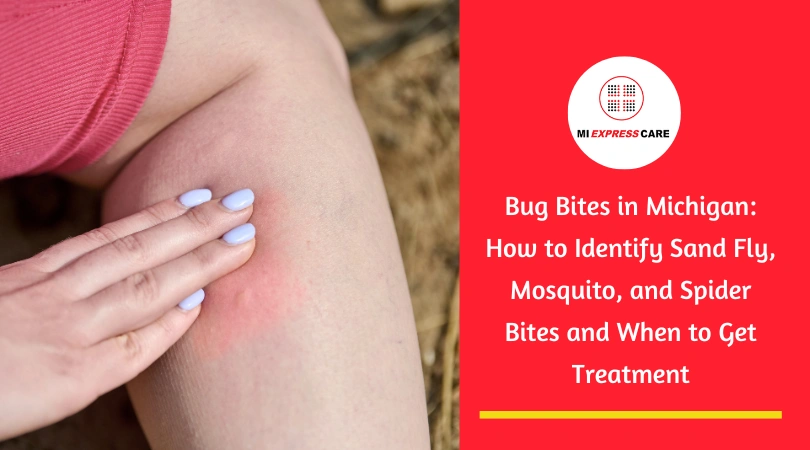
Mosquito bites are the most familiar, raised, round welts with pinkish-red skin around them. They show up fast, itch immediately, and usually appear in multiples on whatever skin was exposed.
For most people, that's the whole story. Mild swelling, a few days of itching, then nothing. But not always. Some bites get scratched open and become infected. Some people have stronger reactions, more pronounced swelling, and prolonged symptoms. And in rare cases, bites from certain mosquito species can transmit illness, though that's less common in Michigan.
If a bite is getting redder and more swollen after 48 hours instead of improving, or if you develop a fever, that's a sign it needs to be evaluated. Otherwise, a cold compress and an antihistamine are usually enough to get through it.
Spider bites tend to cause more alarm than they typically warrant, most spiders in Michigan are not dangerous, and their bites often look no different from any other insect bite. Redness, swelling, and tenderness around a single point are the usual presentation.
What sets spider bites apart is the pain. They tend to be more painful than itchy, and the discomfort can linger. In some cases there's blistering or more noticeable skin changes at the site. Muscle cramps and systemic symptoms are uncommon but do occur with certain species.
Serious spider bites are rare in Michigan. That said, any bite that's causing significant pain, spreading redness, or symptoms beyond the local area should be looked at.
| Feature | Sand Fly Bite | Mosquito Bite | Spider Bite |
|---|---|---|---|
| Appearance | Small, clustered red bumps | Raised, itchy welt | Single, painful bump |
| Itching | Intense | Common | Mild to moderate |
| Pain | Mild | Minimal | Often more pronounced |
| Swelling | Mild | Mild to Moderate | Can be significant |
| Medical Attention | Rarely needed | If infected or severe | If symptoms worsen |
Home treatment works for most bites. But some symptoms should prompt a same-day visit:
A reaction that's still getting worse after 48 hours isn't going to resolve on its own. Earlier treatment is easier.
Infections usually develop when a bite gets scratched open repeatedly, allowing bacteria into the skin. The signs are distinct from normal bite irritation: warmth radiating from the site, increasing tenderness rather than decreasing, visible pus, red streaks tracking away from the bite, swollen lymph nodes, or fever.
A localized skin infection won't clear up without treatment. Left alone, it can spread. Antibiotics are typically straightforward and effective when the infection is caught early.
If a bite is infected, causing a severe reaction, or just not getting better on its own, urgent care is a convenient and efficient option.
No single measure eliminates bug bites entirely, but a few habits make a real difference:
A few simple habits go a long way toward reducing bug exposure during Michigan's outdoor season:
A bug bite shouldn't be the thing that ruins your time outdoors. Knowing how to identify common bites and recognize the warning signs of infection or a serious reaction can make all the difference. If a bite doesn't look or feel right, don't wait it out. Prompt medical care can prevent complications, ease your symptoms, and help you get back to enjoying everything a Michigan summer has to offer.
Not every bug bite needs medical attention, but when redness spreads, swelling worsens, or signs of infection appear, getting prompt care can make all the difference. At MI Express Urgent Care, our experienced providers evaluate insect and spider bites, treat infections and allergic reactions, and help you recover quickly with same-day care.
Walk in today and get the treatment you need to enjoy the rest of Michigan's outdoor season with confidence.
Mosquito bites are usually itchy, raised welts, while spider bites are more often painful, appear as a single bump, and may cause blistering or increased tenderness.
Most sand fly bites are harmless and resolve with home care, though severe itching or signs of infection should be evaluated by a healthcare provider.
Seek medical care if swelling continues to worsen, spreads beyond the bite, affects your face or throat, or is accompanied by fever or difficulty breathing.
Yes, scratching a bug bite can introduce bacteria, leading to redness, warmth, pus, increasing pain, or other signs of infection.
Yes, visit urgent care if a spider bite causes severe pain, spreading redness, blistering, signs of infection, or any concerning symptoms beyond the bite area.