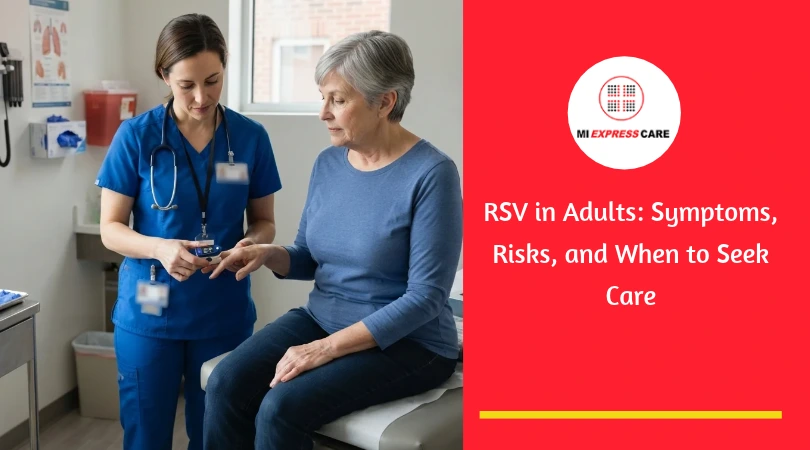



A 68-year-old with asthma or COPD brushes off a "cold" that is entering its second week. RSV in adults can look exactly like that, and it is not just a children's illness.
Most healthy adults get mild symptoms and recover at home. The risk is in who gets it, not in the virus alone: older adults and people with heart or lung conditions can become seriously ill. As the colder months arrive, here is when to rest and when to be seen.
Find the row that sounds most like you, then read on for the details:
If you are 75 or older, or you live with heart or lung disease, it is reasonable to be seen sooner rather than later.
RSV symptoms in adults usually look like a cold that will not quit. The common ones are a runny nose, cough, sneezing, a mild fever, fatigue, and a reduced appetite. Wheezing can show up too.
Symptoms tend to build over several days instead of hitting all at once. The cough is often the last to leave, and it can linger after the rest of you feels better.
CDC says symptoms usually start within 4 to 6 days after infection.
For many people, that is the whole story: a few miserable days, then a slow recovery. Some healthy adults have only mild symptoms, or none at all, which is how RSV can spread without anyone realizing.
For people with asthma or COPD, though, RSV can worsen the underlying lung condition. That is why a cough that turns heavy deserves attention.
Here is how the four illnesses usually compare:
The honest answer is that these illnesses overlap, and they often cannot be told apart without testing. Symptoms alone rarely settle it.
If COVID-19 could be the cause, see our COVID-19 testing page. A yearly flu shot is also worth discussing, since flu can look a lot like RSV and can be serious for the same higher-risk groups.
RSV spreads when a person with the virus coughs or sneezes near you. It also spreads through touch. If you handle a surface that has the virus on it, like a doorknob, and then touch your face before washing your hands, you can become infected.
The virus can survive for many hours on hard surfaces such as tables, and for shorter amounts of time on soft surfaces such as tissues and hands. That is why shared spaces at home and in care settings matter.
RSV season generally starts in the fall and peaks in the winter, though timing varies from community to community and year to year. Having had RSV before does not make you immune, because repeat infections can occur throughout life.
Most healthy adults do fine. Severe illness is more likely in these groups:
CDC estimates that 110,000 to 180,000 adults age 50 and older are hospitalized with RSV in the United States each year.
Most adults with RSV have mild, cold-like symptoms. Some, though, develop pneumonia, an infection in the lungs.
RSV can also lead to worsening of other serious conditions, including asthma, COPD, and heart failure. COPD is a chronic lung disease that makes it hard to breathe. Heart failure means the heart cannot pump enough blood and oxygen through the body.
When RSV adds stress to a body already managing one of these conditions, symptoms that are stable can flare.
Severe RSV can mean hospitalization, and CDC notes it can be fatal for some adults. That is not the usual outcome, but it is why a lingering cough in a higher-risk adult is worth taking seriously.
How long does RSV last in adults? Most feel better within a week or two, and a cough can linger longer than that.
How long is RSV contagious? CDC says people with RSV are usually contagious for 3 to 8 days, and they can start spreading it a day or two before they feel sick. People with weakened immune systems may spread it for 4 weeks or longer.
That is why a mild case in a healthy adult can quietly pass RSV to an older relative or an infant.
Stay home while you are sick, wash your hands often, and cover coughs and sneezes. Keep your distance from higher-risk people, and use extra care around them until you have fully recovered.
Plan to be seen if you notice any of these:
These signs matter because they can point to a lung infection, such as pneumonia, or to an existing condition flaring up. Being seen early lets a provider act before things get worse.
At urgent care, a provider can check your breathing and oxygen levels, look for pneumonia, and recommend next steps. On-site X-ray can help evaluate the lungs, and pneumonia treatment is available if a lung infection is found.
Bluish lips, severe trouble breathing, or confusion means call 911 or go to the ER right away. Do not wait for a visit.
There is no specific cure for RSV, and CDC notes that antiviral medicine is not routinely recommended. Treatment focuses on easing symptoms while your body clears the virus.
Rest, drink plenty of fluids, and use over-the-counter symptom relief for fever, aches, and congestion.
If you have heart disease, kidney disease, high blood pressure, or take several medicines, check with a provider before choosing an over-the-counter product. Some can interact with other conditions or medicines.
Keep taking your regular medicines as directed, and follow your asthma or COPD action plan if you have one. Keep rescue medicine within reach, and tell your provider if you are using it more often than usual.
It also helps to check in with yourself each morning and evening, including how your breathing feels. A small change is easier to catch that way.
Feeling a little better each day is a good sign. Feeling worse is a reason to be seen.
Prevention starts with everyday habits that also protect the people around you. Wash your hands often, cover coughs and sneezes, and clean frequently touched surfaces such as doorknobs. Stay home and away from others when you are sick.
Cleaner air can help too. Bring in outside air when you can, use an air purifier, or meet outdoors.
CDC also recommends an RSV vaccine for all adults 75 and older, and for adults 50 to 74 who are at increased risk of severe RSV. Talk with your provider about whether a vaccine is right for you.
It is easy to tell yourself a cough is nothing, especially when you do not want to make a fuss. But a heavier cough, or a chest that feels tighter than usual, is worth listening to before it becomes an emergency.
If you are unsure, walk in to MI Express Urgent & Primary Care in Canton or in Ann Arbor. The care team can check your breathing and oxygen levels, look for pneumonia, and talk through what comes next.
Have questions first? Contact us and the care team can help you decide whether to come in.
Yes. Most healthy adults have mild, cold-like symptoms, while older adults and people with heart or lung conditions can become seriously ill.
CDC says people with RSV are usually contagious for 3 to 8 days, and people with weakened immune systems may spread it for 4 weeks or longer.
The symptoms overlap and often cannot be told apart without testing, so a worsening cough or new wheezing is a reason to be seen.
Adults 75 and older, and those with chronic heart or lung disease, diabetes, kidney disease, weakened immune systems, or a long-term care residence.
Walk in for a worsening cough, wheezing, or a returning fever, and go to the ER for bluish lips, severe trouble breathing, or confusion.