


Last Updated: Apr 17, 2026
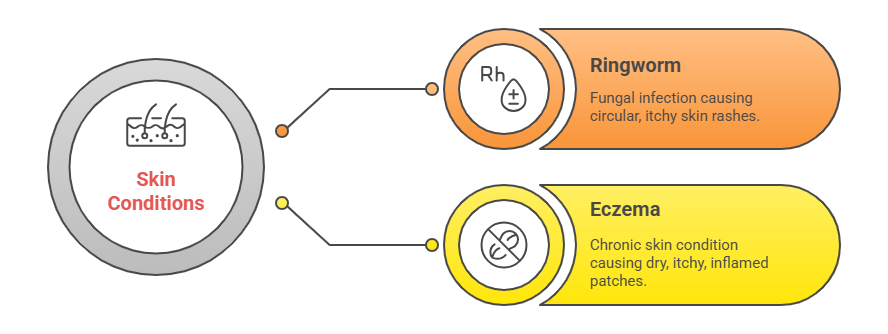
Both ringworm and eczema can cause red, circular, itchy rashes which is why so many people confuse the two. But they are fundamentally different conditions. Ringworm is a contagious fungal infection caused by a dermatophyte called tinea corporis. Eczema, on the other hand, is a chronic inflammatory skin condition triggered by immune responses, allergens, or skin barrier breakdown and it is not contagious at all.
Getting the diagnosis right matters because the treatments are completely different. Applying an antifungal cream to eczema will do nothing, and a corticosteroid cream on ringworm can actually make the infection worse. If you are unsure which condition you are dealing with, read on and visit our team at MI Express Urgent Care for a fast, accurate diagnosis.
Eczema is an umbrella term for a group of inflammatory skin conditions that cause dry, itchy, and irritated skin. The most common forms include:
According to the National Eczema Association, nummular eczema specifically affects about 2 in every 1,000 adults in the U.S., accounting for approximately 3.5% to 7% of all adult eczema cases. The exact cause is not fully understood, but common triggers include dry or sensitive skin, a history of skin injuries or bacterial infections, cold or dry environments, and prior use of topical medications. People with allergies or asthma are at elevated risk.
Despite its name, ringworm has nothing to do with worms. It is a highly contagious fungal infection caused by dermatophyte fungi most commonly Trichophyton, Microsporum, or Epidermophyton species collectively called tinea corporis when found on the body. It can also appear on specific body regions with different names: tinea capitis (scalp), tinea pedis (athlete's foot), and tinea cruris (jock itch).
Ringworm spreads through direct skin-to-skin contact, sharing personal items such as towels or razors, contact with infected animals (especially cats and dogs), and walking barefoot in warm, moist public spaces like gym locker rooms or swimming pools. It is especially common among children and athletes.
Also read: Is a Poison Ivy Rash Contagious?
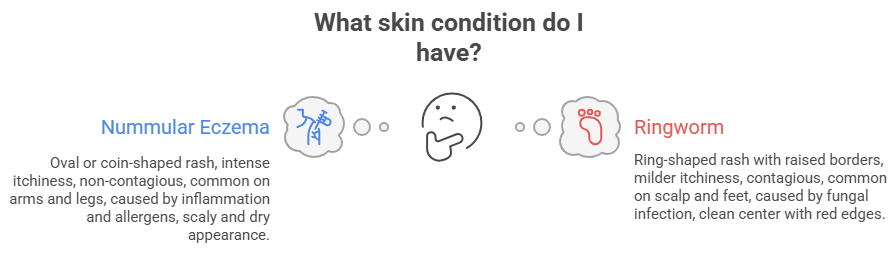
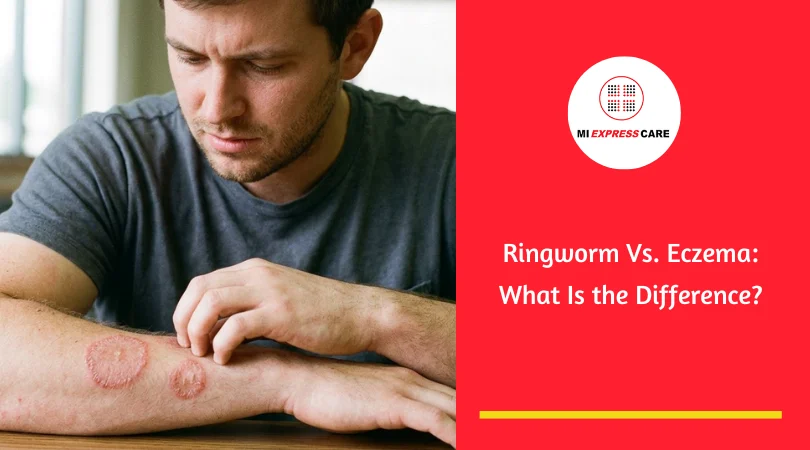
Ringworm almost always forms a ring a circular or oval rash with a red, raised, scaly outer border and a clearer center. The edge is typically well-defined. Eczema patches are less uniform they may be oval or irregular, without a clear inner clearing. Nummular eczema patches look like coins round but solid throughout, not ring-like.
If others in your household or team are developing similar rashes after close contact, ringworm is far more likely. Eczema cannot pass from person to person. However, scratched eczema skin can develop secondary bacterial infections (commonly Staphylococcus aureus) that may require antibiotics another reason to get a proper evaluation through our injuries and illness urgent care services.
People with eczema typically have a personal or family history of atopic conditions eczema, asthma, or hay fever. Ringworm tends to appear after a specific exposure event a new pet, a wrestling match, a gym trip, or sharing personal items with an infected person.
Eczema most commonly appears on the elbows, knees, wrists, hands, and face. Ringworm can develop anywhere including the scalp and nail beds which is uncommon for eczema. If you notice a rash on your scalp with patchy hair loss, or a skin rash that looks similar to scabies or another skin parasite, a clinical exam is the fastest way to know for sure.
The causes and risk factors for ringworm include:
Most cases of ringworm respond well to over-the-counter antifungal creams common active ingredients include clotrimazole (Lotrimin), terbinafine (Lamisil), and miconazole. These are typically applied once or twice daily for 2 to 4 weeks. Prescription-strength antifungals (oral fluconazole or itraconazole) may be needed for scalp ringworm, widespread infections, or cases in immunocompromised patients.
Important hygiene steps during treatment include washing all bedding and clothing, avoiding sharing personal items, keeping affected skin dry, and not scratching. Scalp ringworm in children often requires oral antifungal medication since topical creams do not penetrate the hair follicle effectively.
Eczema has no permanent cure, but symptoms can be effectively managed. First-line treatments include topical corticosteroids (hydrocortisone for mild cases, betamethasone or triamcinolone for moderate-to-severe), emollients and moisturizers applied multiple times daily to restore the skin barrier, and calcineurin inhibitors (tacrolimus, pimecrolimus) for sensitive areas or steroid-sparing therapy.
For severe or widespread atopic dermatitis, a doctor may recommend immunosuppressants or newer biologic treatments such as dupilumab. Lifestyle management is equally important wearing soft, breathable cotton clothing, using fragrance-free detergents, maintaining indoor humidity, and identifying personal triggers. For patients with linked allergy conditions, addressing the underlying allergy can significantly reduce eczema flare frequency.
A clinician can usually distinguish between ringworm and eczema through a visual examination alone. If there is uncertainty, a KOH (potassium hydroxide) preparation a simple, quick skin scraping test can confirm the presence of fungal elements under a microscope. A Wood's lamp examination (ultraviolet light) may also be used, as some ringworm-causing fungi fluoresce under UV light.
For eczema, diagnosis is primarily clinical based on appearance, distribution, and history of atopic conditions. A patch test may be ordered to identify specific contact allergens. If a secondary skin infection is suspected, a skin swab for culture may be performed. MI Express Urgent Care offers on-site lab services to support fast, accurate diagnoses during your visit.
You should seek medical evaluation for a skin rash if:
At MI Express Urgent Care, you can walk in without an appointment and be seen promptly. Our providers can diagnose skin rashes visually, perform skin tests where needed, and prescribe appropriate treatment on the same visit. We serve patients in Canton, MI and Ann Arbor, MI. For children, our pediatric urgent care team is experienced in evaluating pediatric skin conditions including ringworm and eczema.
Not sure whether your rash is ringworm, eczema, or something else entirely? Our board-certified providers at MI Express Urgent Care can evaluate your skin, run tests if needed, and start you on the right treatment all in a single walk-in visit. We accept most major insurance plans. Visit us in Canton or Ann Arbor — no appointment necessary.
Yes. Nummular eczema forms oval, coin-shaped patches that closely resemble ringworm. The key difference is that eczema patches are solid throughout they lack ringworm's clear center and raised ring border.
Check for a ring shape with a clearer center that points to ringworm. If the rash is solid, very itchy, and you have a history of atopic conditions, eczema is more likely. A doctor can confirm with a quick skin test.
Yes. Ringworm spreads through skin-to-skin contact, shared personal items, and contact with infected animals. Eczema, by contrast, is not contagious and cannot be passed from one person to another.
No. Ringworm is a fungal infection; eczema is an inflammatory skin condition. They are separate diseases and one does not convert into the other, though both can sometimes coexist on the same person's skin.
Ringworm rarely clears without treatment. OTC antifungal creams typically resolve it within 2 to 4 weeks. Without treatment, the infection tends to spread and persist, particularly in immunocompromised individuals.
Antifungal cream will not treat eczema since eczema is not caused by a fungus. It will not harm the skin, but it will delay proper treatment. Similarly, using corticosteroid cream on ringworm can worsen the infection.