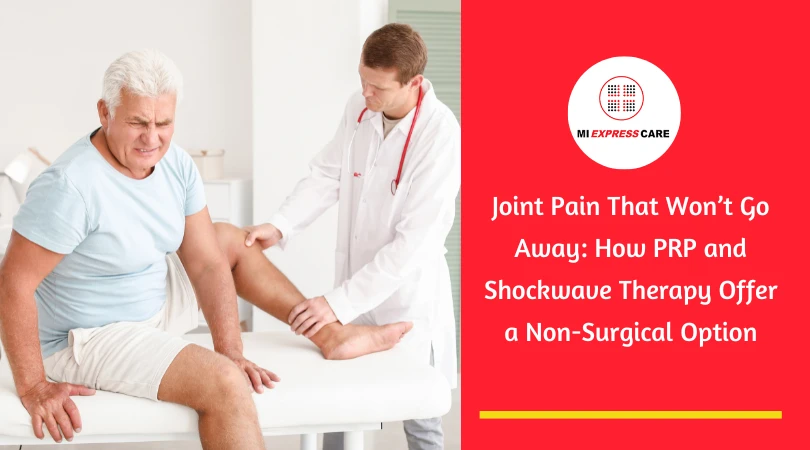



Ongoing joint pain can significantly impair mobility, disrupt sleep patterns, impact workplace productivity, and diminish everyday comfort. When standard conservative treatments fail to provide lasting relief, many patients seek effective interventions but want to avoid the risks, costs, and recovery times associated with surgery.
Recent advances in regenerative medicine offer proven, non-surgical options designed to reduce localized pain and actively support tissue healing. Platelet-Rich Plasma (PRP) therapy and shockwave therapy are two of the most widely utilized and clinically discussed treatments for persistent musculoskeletal and joint pain.
Here’s how these therapies work, who they may help, and when it may be time to explore treatment.
Chronic joint pain often persists because the underlying structural damage or inflammation exceeds the body's natural capacity to repair itself.
Common medical causes requiring targeted joint pain treatment include:
These conditions present through a distinct cluster of ongoing symptoms, including localized stiffness, swelling, pain during movement, reduced range of motion, and pain that returns repeatedly after periods of rest.
Initially, standard conservative management is the first line of defense. Patients routinely attempt a combination of rest, ice and heat application, targeted stretching, formal physical therapy, and over-the-counter anti-inflammatory medications.
While effective for acute injuries, chronic joint conditions often cause pain to continue or return once normal physical activity resumes. That’s often when patients start exploring non-surgical joint pain relief options to avoid long-term medication reliance or surgical intervention.
Platelet-Rich Plasma (PRP) therapy is an autologous treatment that utilizes the patient’s own blood components to stimulate localized healing.The clinical protocol involves:
The concentrated growth factors within the platelets actively support tissue healing, accelerate cellular recovery, and reduce chronic discomfort over time.
PRP therapy is commonly applied to large and small joints, including:
Ideal candidates include individuals with chronic joint pain that has failed to improve with physical therapy, active adults or athletes looking to safely accelerate recovery, and patients seeking an alternative to surgery.
Extracorporeal shockwave therapy is a non-invasive treatment that delivers high-energy acoustic waves through the skin to the site of chronic injury. This mechanical stress stimulates a localized biological healing response, increasing blood flow, breaking down calcified deposits, and promoting collagen synthesis. Consequently, shockwave therapy for joint pain helps improve both mechanical comfort and long-term joint function.
This therapy is highly effective for dense, tendon-to-bone attachment sites, including:
Patients favor shockwave therapy because it is entirely non-invasive, requires minimal to no downtime, and is performed as a brief, in-office clinical procedure.
The optimal clinical choice depends entirely on the specific underlying pathology, joint anatomy, and overall patient goals.
Yes, combination protocols are frequently recommended for complex or multi-tissue injuries. Because shockwave therapy enhances microcirculation and cellular permeability, it can prepare the target tissue to better absorb and utilize the regenerative growth factors delivered via PRP injections. Individualized treatment plans are required to properly space and sequence these therapies for maximum clinical efficacy.
You May Benefit If You:
These therapies may not be clinically appropriate for individuals with severe, end-stage bone-on-bone joint damage that requires surgical replacement. They are also contraindicated for patients with active localized infections, systemic bleeding disorders, or certain concurrent medical conditions affecting cell function.
Clinical intervention should be pursued if you experience:
Ongoing joint pain doesn’t always mean surgery is the only solution.
Treatments like PRP therapy and Shockwave Therapy offer non-surgical options that may help support healing, reduce discomfort, and improve joint function in appropriately selected patients.
While they are not a cure-all, they can be valuable tools when conservative treatments haven’t provided enough relief.
The most important step is understanding what is actually causing your pain, and choosing a treatment plan that matches your condition and lifestyle goals.
If joint pain is limiting your movement or returning despite rest and treatment, it may be time to explore advanced non-surgical options. At MI Express Urgent & Primary Care, we offer personalized evaluations and regenerative treatments such as PRP therapy and Shockwave Therapy to help address chronic joint pain at its source.
Our focus is to reduce discomfort, improve mobility, and support long-term joint health without surgery.
Schedule your appointment today to find out which treatment approach may be right for you.
Many patients begin noticing improvement within several weeks, although results can vary depending on the condition being treated and individual healing response.
Most patients tolerate shockwave therapy well. Some may experience mild discomfort during treatment, but sessions are generally brief and require little to no downtime.
Coverage varies by insurance provider and treatment indication. Many regenerative treatments are considered elective, so it's best to verify benefits with your provider.
PRP may be used as part of a treatment plan for certain patients with knee arthritis. A healthcare provider can determine whether it is appropriate based on the severity of the condition.
Treatment plans vary, but many patients undergo a series of sessions over several weeks to achieve optimal results.