


It is Sunday evening, and a daughter is sorting out her mother's week: a cardiology follow-up on Tuesday, a new blood pressure tablet to track, and a recent fall she keeps replaying. Assisted living medical care can feel like a puzzle whose pieces are held by different people.
Underneath it all sits one simple question: who is the one physician who knows how my parents are doing day to day?
Many families are never given a clear answer, and it is a fair thing to ask. This guide explains how a physician-led approach works, so you can ask better questions and feel steadier about the answers.
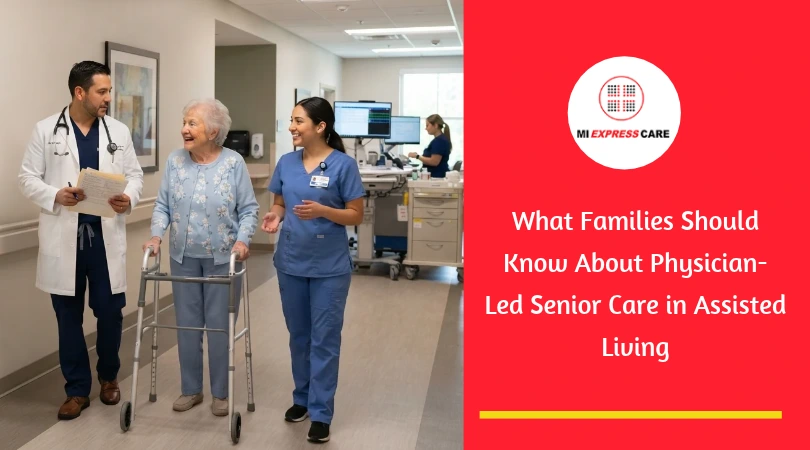
Visiting physician services bring the doctor to the resident. Instead of arranging a ride to an office, the resident is seen at their own community, in familiar surroundings.
"Physician-led" describes who steers the care. The physician directs the care plan and makes the medical decisions, while the resident, the family, and community staff all stay closely involved.
This kind of primary care for seniors is available to communities in Canton and Ann Arbor. For families, it can replace a scattered set of appointments with one steady point of medical contact.
Care staff handle the daily rhythm of assisted living. They help with bathing, meals, and medication reminders, and they often know a resident's habits better than anyone.
Medical evaluation and treatment decisions come from a licensed provider. These are two different jobs, and neither replaces the other.
When both sides share what they see, a resident gets daily observation and medical judgment working together. That is a strength of the setting, not a shortcoming of any community.
Services and rules differ from one community to the next and from state to state, so it is worth asking how medical care is arranged where your parents live.
Geriatric primary care pulls many threads into one ongoing relationship. A typical visit can include:
Not every resident needs every item at every visit. The physician sets the focus based on the person in front of them.
Three practical details matter most to families: how often the physician visits, how residents are scheduled, and how the physician keeps staff and family informed. Each care arrangement sets these a little differently, so ask for the specifics when you begin the conversation.
A good arrangement answers all three clearly. You should know when to expect a visit, who arranges it, and where updates will come from afterward.
Between visits, community staff remain the day-to-day eyes on a resident. They can pass along anything that needs the physician's attention.
When the same physician sees a resident over time, small changes stand out. A quieter mood, a less steady step, or a smaller appetite means more to someone who remembers what last month looked like.
Fewer trips can also mean less disruption. Travel to an appointment is tiring for many seniors, and waiting rooms, transfers, and unfamiliar spaces add to it.
Being seen at home can make care easier to accept. A resident who dreads a long afternoon out may feel calmer in their own space.
Continuity helps the family too. Instead of retelling a parent's story to someone new each time, you build on a relationship that already exists.
Your role does not shrink when a physician is involved. It changes shape, and a few habits make it easier.
Start with the paperwork that keeps everyone aligned: an up-to-date medication list, current advance directives, and current contact information. Name one family member as the point of contact, so the care team is never guessing who to call. Ask to be included in care updates.
Then trust what you notice. If your parent's appetite, mood, or mobility seems different, say so. You see them in ways no chart can.
Asking is not a sign of distrust. It is how families learn how assisted living medical care really works. These questions suit any community, whichever physician or group it uses:
Straight answers are a good sign, and a thoughtful community will be glad you asked.
Visiting care is not limited to assisted living. Residents of independent living communities can be seen by a visiting physician too, which can be a welcome option for people who are active but would rather skip the drive to an office.
If your parents live in an independent living community, the same questions above apply.
Handing over part of a parent's care takes trust, and it is natural to want to understand it fully first. There is no pressure to have all the answers before you reach out.
MI Express Urgent & Primary Care provides physician-led primary care for seniors where they live, so residents stay connected to a physician who knows them.
Families and community administrators are both welcome to contact us with questions, or to talk through how visiting physician services could work for a community or a loved one.
Staff assist with daily living, and medical decisions come from a licensed provider. What is offered varies by community and state.
A physician visits residents in their own community, so they do not have to travel to an office.
It depends on the community's policies, so check with the community directly.
Ask to be added to care updates, and name one family contact.
Yes, independent living residents can be seen by a visiting physician too.