


Most people don't consider a medical weight loss program until they've already tried losing weight on their own, often more than once. This isn't about dismissing those efforts. For plenty of people, a self-directed plan works. But if you keep hitting the same wall, it helps to understand what actually changes when a doctor is part of the process.
Here is what we will cover: what medical weight loss includes, why do-it-yourself dieting so often plateaus, and how to tell which path fits your situation.
Most diets focus on the same two levers: what you eat and how much. That is a reasonable starting point, but it leaves out the part of the equation that makes weight loss genuinely hard for many people, which is biology. Hormones, metabolism, thyroid function, and insulin resistance all influence how your body stores and releases weight. A meal plan alone does not account for any of that.
The other issue is that self-directed dieting runs on trial and error. There is no lab work to reveal what is happening underneath, no monitoring to catch a problem early, and no one adjusting the plan when progress stops. So the pattern tends to repeat itself:
That is not a willpower failure. It is a gap in the approach.
Medical weight loss is a physician-supervised program built around your actual health data rather than a generic template. Instead of guessing, your provider reviews your labs, your medical history, and your current medications, then designs a customized weight loss plan around what they find.
A typical program includes:
The key word is supervised. If medication is part of your plan, it is one tool inside a larger strategy, not the whole thing.
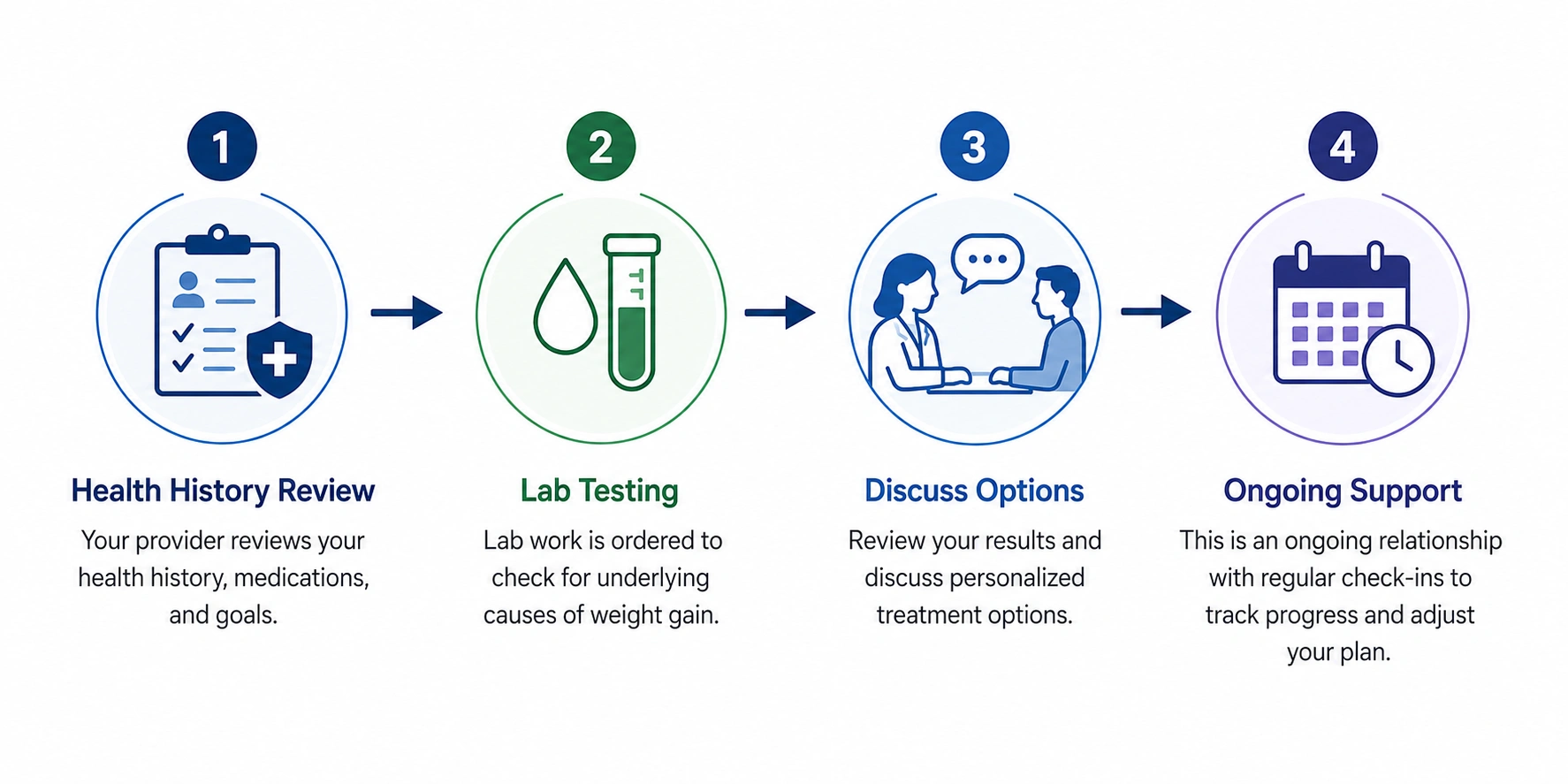
Your first visit is a conversation. Your provider reviews your health history, current medications, weight history, and goals to understand the full picture.
From there, labs are typically ordered to rule out underlying causes of weight gain. Commonly checked:
Once results are in, you will discuss your options, whether that is nutrition coaching on its own or nutrition paired with medication, based on your individual profile.
One expectation to set early: this is not a single visit. It is an ongoing relationship with regular check-ins, so the plan can adapt as you go.
Honestly, not for everyone. If you respond well to a structured diet and exercise plan you can manage on your own, you may not need a medical program at all.
Where it tends to make the biggest difference is in specific situations:
In those cases, medical supervision is not an upgrade for its own sake. It is the right next step for a particular set of circumstances.
No. Nutrition counseling, behavioral coaching, and monitoring are part of every program. Medication is offered when it is clinically appropriate, not automatically.
For context, GLP-1 medications work by helping regulate appetite and blood sugar, which can make dietary changes easier to sustain. Like any medication, they carry potential side effects, commonly nausea or digestive discomfort, especially early on. That is exactly why supervision matters. A provider can weigh whether they fit your health profile and monitor how you respond.
DIY dieting works for plenty of people, and there is no shame in having tried it. But when plateaus keep showing up, or underlying health factors are at play, that is where medical supervision earns its place. The goal is not to replace your effort. It is to give it the support and precision it may have been missing.
Discover how a doctor-supervised program can succeed where diet after diet has stalled. At MI Express Urgent & Primary Care, our team builds your plan around your labs, health history, and goals, showing how medical supervision targets the underlying causes of weight gain more precisely than diet changes alone.
Schedule your consultation today and take the first step toward lasting, medically guided weight loss.
It varies based on your starting point, health profile, and the plan you follow. Rather than promising a specific number, a medical program sets realistic, sustainable targets and adjusts them as you progress.
Coverage differs by plan and by which services are involved. Some components may be covered while others are not. Our team can help you understand your options before you start.
A regular diet plan focuses mainly on food and calories. Medical weight loss is supervised by a physician and built around your labs, medical history, and individual health needs, with ongoing monitoring and adjustments.
In most cases, yes. Lab work helps identify underlying causes of weight gain, such as thyroid or metabolic issues, so your plan can be tailored to what is actually happening in your body.