


With a confirmed Cyclospora outbreak spreading across Southeast Michigan in 2026, residents have a lot of questions. Is cyclospora contagious? How is it spread? Can it come back after treatment? What foods should you avoid? This post answers the most common questions our providers are hearing right now, in plain language, based on current public health guidance.
For a deeper dive into any specific topic, see our posts on cyclospora symptoms, cyclospora treatment, and the Michigan Cyclospora outbreak 2026.
No. This is one of the most important facts to understand during the current outbreak. Cyclospora cayetanensis is not spread through contact with an infected person. You cannot contract it by being near someone who is sick, touching them, sharing utensils, or any other form of person-to-person contact.
Cyclospora spreads only through the ingestion of food or water that has been contaminated with Cyclospora oocysts. If someone in your household is infected, you are not at risk from contact with them, though you may have shared exposure to the same contaminated food source.
Cyclospora reaches the United States primarily through contaminated fresh produce. Previous U.S. outbreaks have been linked to:
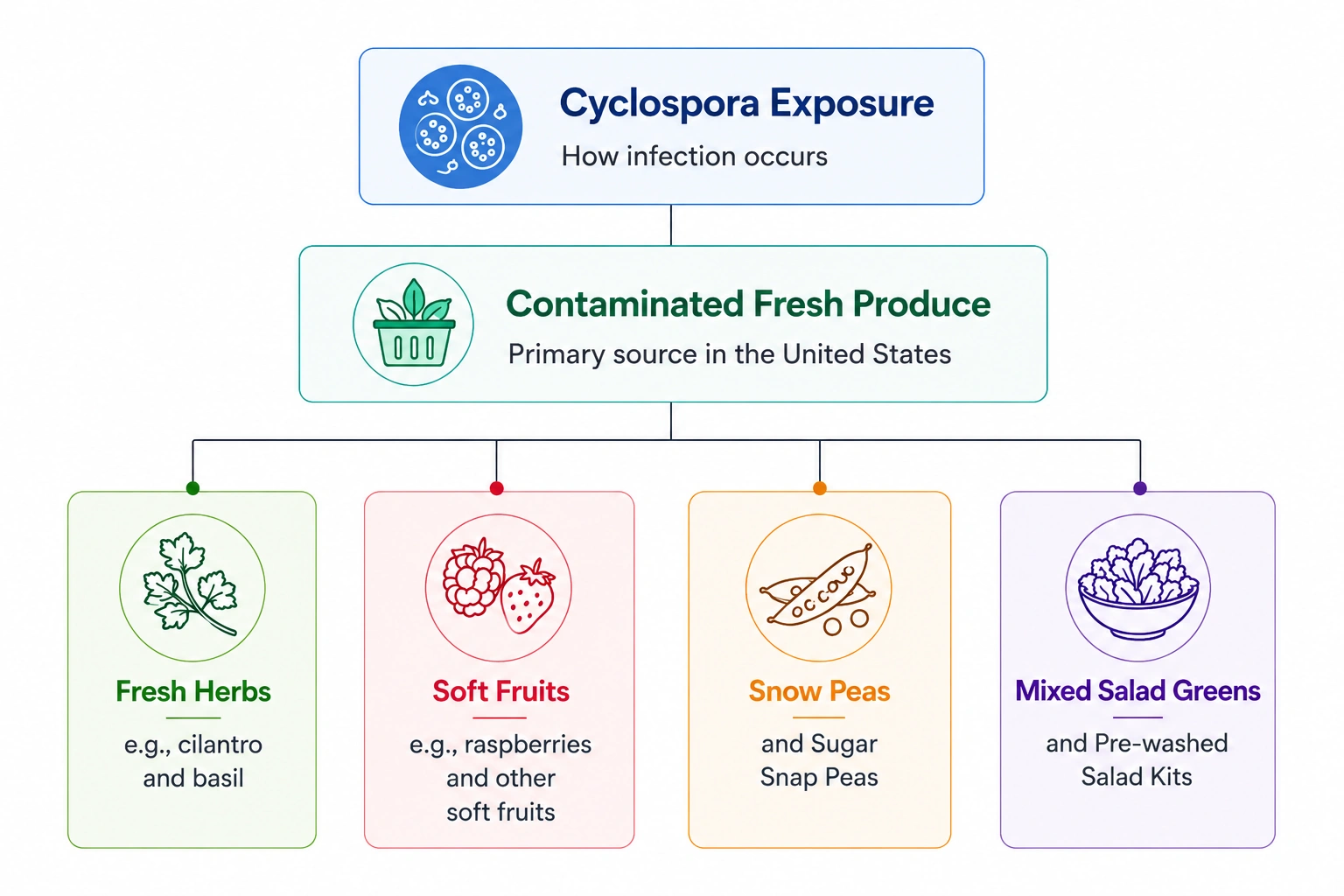
The parasite's oocysts are not killed by standard washing under running water. The CDC recommends washing all fresh produce thoroughly before eating, though this does not guarantee elimination of oocysts. Cooking produce to proper internal temperatures does destroy the parasite.
Because no specific contaminated food source has been identified in the 2026 Michigan outbreak, there is no single food item to avoid. However, given that past outbreaks have involved fresh herbs and produce, taking care with raw produce is reasonable during this period.
Practical steps include washing all fresh produce under running water before eating, considering cooked alternatives to raw salad greens and herbs if you are at higher risk, and staying informed through the MDHHS outbreak updates page as the investigation continues.
Yes. Heat destroys Cyclospora oocysts. Cooking produce to appropriate internal temperatures eliminates the risk of infection from that food. Fresh produce consumed raw, such as salad greens, herbs, and soft fruits, carries the exposure risk during an outbreak. Cooked vegetables and fruits that have been heated through do not.
Two scenarios can result in a return of symptoms after treatment. The first is incomplete clearance: if the full 10-day antibiotic course is not completed, the parasite may not be fully eliminated, and symptoms can return. Completing the entire prescribed course is important.
The second is reinfection: there is no lasting immunity from a prior Cyclospora infection. If you are re-exposed to contaminated food or water after recovering, you can be infected again. During the current outbreak, continuing to take care with fresh produce remains important even after recovery.
Without treatment, cyclosporiasis typically lasts anywhere from a few days to a month or longer. The illness often follows a relapsing course, with symptoms improving and then returning over several weeks. This is the most clinically significant aspect of untreated Cyclospora: it is not a short illness, and it tends not to simply resolve on its own within a reasonable timeframe.
For most healthy adults, cyclosporiasis is an unpleasant illness but not life-threatening. The main risks are dehydration from prolonged diarrhea and significant weight loss and fatigue in cases that go untreated for weeks. In immunocompromised individuals, the elderly, and young children, the illness can be more severe and may warrant closer monitoring.
If you are in a higher-risk category or your symptoms are severe, a provider can evaluate whether additional supportive care is needed. See the CDC cyclosporiasis fact sheet for the public for additional public health guidance.
Testing for Cyclospora requires a stool specimen. The key point: you must specifically request Cyclospora testing, or ask your provider to include it on the lab order. A routine stool culture will not detect Cyclospora.
The preferred method during the current Michigan outbreak is multiplex PCR testing (such as the BioFire GI panel), which is more sensitive and comprehensive than traditional staining-based methods. Walk in to any MI Express Urgent & Primary Care location, describe your symptoms, and mention the current outbreak. Your provider will ensure the correct test is ordered.
Walk-in visits are welcome at all MI Express Urgent & Primary Care locations. You do not need a referral or a scheduled appointment to be evaluated for GI illness. Providers can assess your symptoms, order stool testing, and, if an infection is confirmed and treatment is appropriate, prescribe medication on the same visit.
No. Cyclospora does not spread from person to person. However, family members who ate the same contaminated food as you may have been independently exposed to the same source.
Get tested if you have had watery diarrhea lasting more than a few days, particularly with the relapsing pattern of symptoms improving and then returning, or if you have loss of appetite and unexplained fatigue alongside GI symptoms.
Cyclospora is a parasitic infection spread through contaminated food, which overlaps with the general concept of foodborne illness. However, it is a parasite, not a bacterium, and its treatment differs from typical bacterial food poisoning.
Because Cyclospora does not spread person to person, you are not a risk to coworkers through normal workplace contact. However, frequent diarrhea and fatigue may make returning to work difficult until symptoms are controlled.
The MDHHS publishes updates on the 2026 Michigan Cyclospora outbreak at michigan.gov/mdhhs. Your local health department is also a resource for county-level case updates and guidance.